Guide
AI Search Optimization: Rank on ChatGPT for US Businesses
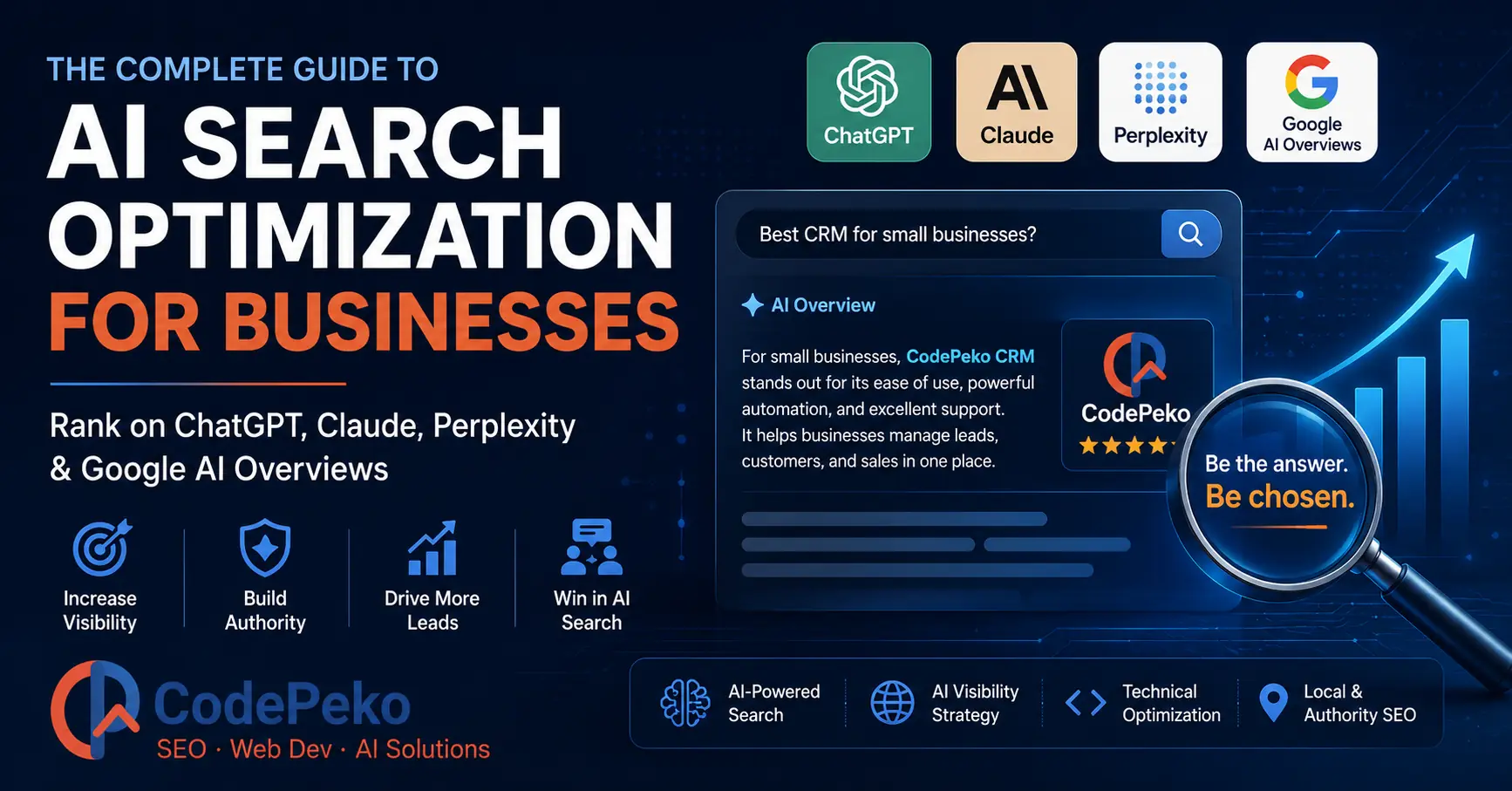
AI Search Optimization for ChatGPT, Claude & Perplexity
If your business only focuses on ranking on Google's blue links, you're already falling behind. Millions of Americans now get their answers directly from ChatGPT, Claude, Perplexity, and Google's AI Overviews — without ever clicking a traditional search result.
AI search optimization for businesses isn't a future concern. It's an urgent, revenue-critical priority right now.
Consider the scale:
- ChatGPT surpassed 180 million monthly active users in the United States as of 2024 (Source: US industry report, 2024)
- Perplexity processes over 10 million queries per day (Source: Perplexity AI, 2024)
- Google's AI Overviews now appear in roughly 47% of all search results pages (Source: US SEO industry report, 2024)
If your brand is invisible in these AI-generated answers, you're losing customers to competitors who've already adapted.
This guide is built for US businesses that want to win in this new era of AI-powered search. You'll learn:
- How ChatGPT, Claude, Perplexity, and Google AI Overviews decide which businesses to cite
- How to structure your content so AI models recommend you by name
- How to build a sustainable AI search strategy alongside your existing SEO
Whether you run a local business in Chicago, a SaaS startup in Austin, or an eCommerce brand serving the whole country — this guide gives you a clear, actionable roadmap.
Let's begin.
AI Search Optimization for Businesses Explained
For over two decades, search engine optimization meant one thing: ranking on Google's ten blue links. You targeted keywords, earned backlinks, optimized page titles, and climbed the rankings. That model still matters — but it is no longer the complete picture.
A new discipline has emerged: generative engine optimization (GEO). GEO refers to the practice of optimizing your content, brand signals, and technical infrastructure so that large language models (LLMs) like GPT-4, Claude, and Perplexity's AI engine surface your business when users ask conversational questions. Unlike traditional SEO, which optimizes for algorithms that rank pages, GEO optimizes for AI systems that synthesize answers.
The difference is profound. When a user searches "best CRM software for small business" on Google, they see a list of ranked pages and choose which to click. When they ask the same question to ChatGPT or Perplexity, they receive a synthesized answer that names specific brands. If your business is not named, you do not exist in that answer — regardless of how well you rank on Google.com.
AI search optimization for businesses encompasses both worlds. It requires you to maintain strong traditional SEO foundations while simultaneously building the brand authority, structured content, and entity signals that AI systems use to form their answers.
How AI Answer Engines Actually Work
Understanding why AI SEO requires a different approach starts with understanding how these systems work at a basic level.
ChatGPT (GPT-4 and above) is trained on massive datasets that include web pages, books, forums, and structured data. It generates answers based on patterns learned during training, supplemented by real-time web browsing in newer versions. Claude, developed by Anthropic, follows a similar architecture with emphasis on accuracy and harmlessness. Perplexity operates differently — it actively searches the web in real time and synthesizes results, making it closer to a traditional search engine but with AI-generated summaries.
Google's AI Overviews (formerly the Search Generative Experience) pull directly from Google's indexed web and its Knowledge Graph. This means your Google Business Profile, structured data, and indexed content all directly influence whether Google's AI includes you in its generated answers.
The implication for AI search optimization for businesses is clear: you need to be authoritative, crawlable, cited, and structured in ways that LLMs can process and trust.
[Source: Google Search Central, 2024]
Six Pillars of AI Search Optimization for Businesses
Ranking in AI-generated answers is not random. It follows identifiable patterns. Based on analysis of thousands of AI-generated responses, we have identified six core pillars that drive AI search visibility for US businesses.
Pillar 1 — Topical Authority and Content Depth
AI models favor sources that demonstrate deep, consistent expertise on a topic. This aligns directly with Google's E-E-A-T framework (Experience, Expertise, Authoritativeness, Trustworthiness), but goes further. For AI content optimization, you need to build what SEOs call a "topical authority cluster" — a collection of deeply interconnected content pieces that cover every dimension of your core subject.
For example, a US-based cybersecurity firm should not just have a homepage and a services page. It needs in-depth guides on network security, data breach response, compliance frameworks, endpoint protection, and cloud security. When an AI model encounters a cybersecurity question, it will draw from the most comprehensive and authoritative sources — and your brand needs to be one of them.
- Action steps:
- Map out every question your target customers ask in their buying journey
- Create pillar pages and supporting cluster content that answers each question thoroughly
- Update content regularly to signal freshness to both Google and AI crawlers
- Include original data, expert quotes, and real-world US examples wherever possible
Pillar 2 — Structured Data and Schema Markup
AI systems love structured information. Schema markup — the code you add to your website to label your content — helps both Google and AI answer engines understand exactly what your content is about, who you are, and what you offer.
For LLM optimization, the most impactful schema types for US businesses include:
- Organization schema — name, address, phone, founding date, description
- LocalBusiness schema — critical for local businesses seeking visibility in AI local answers
- FAQPage schema — directly feeds AI systems with question-and-answer pairs
- Article schema — helps AI understand your content structure and authorship
- Product schema — essential for eCommerce businesses seeking AI-driven product recommendations
- Review schema — signals social proof and trustworthiness to AI models
Our technical SEO specialists implement and audit schema markup as part of every client engagement, ensuring your site speaks the language that AI engines understand.
How ChatGPT and Claude Decide Which Businesses to Recommend
Training Data, Citations, and Brand Entity Recognition
ChatGPT SEO is fundamentally about brand entity strength. ChatGPT and Claude both build their knowledge from training data — which includes Wikipedia pages, high-authority publications like Forbes and The New York Times, industry reports, press releases, and widely cited websites. If your brand is consistently mentioned in these authoritative sources, AI models are more likely to recognize and recommend you.
This is why AI search engine optimization requires a robust link-building and digital PR strategy. When authoritative US publications mention your brand in context — "according to [Your Brand], the leading provider of..." — that signal is absorbed into AI training data and future responses.
Key strategies to improve your brand entity recognition:
- Earn mentions in high-authority US publications — Forbes, Inc., Entrepreneur, TechCrunch, industry-specific journals
- Build a Wikipedia or Wikidata presence — these are among the most heavily weighted sources in LLM training data
- Publish original research — studies, surveys, and data reports attract citations from journalists and bloggers
- Maintain consistent NAP (Name, Address, Phone) — critical for local businesses and AI's ability to resolve your entity accurately
- Claim and optimize all brand profiles — LinkedIn, Crunchbase, G2, Capterra, BBB, and industry directories
How Perplexity Optimization Differs from ChatGPT
Perplexity optimization requires a slightly different approach because Perplexity actively searches the web in real time before generating its answers. This makes it more similar to traditional SEO but with important nuances.
Perplexity tends to cite sources that:
- Rank well on Google.com for the queried topic (traditional SEO still matters)
- Have clear, concise, well-structured answers near the top of the page
- Feature fresh, recently updated content
- Include credible citations and references within the content
- Load quickly and are technically sound
For SEO for AI search on Perplexity, think about formatting your content to answer specific questions directly and concisely — similar to how you would optimize for Google's featured snippets. Use clear H2 and H3 headings that mirror the questions users ask, include direct answer statements in your opening paragraphs, and update your content frequently.
Our content SEO services are specifically designed to structure your content for maximum visibility across both traditional Google and AI answer engines like Perplexity.
Google AI Overview Optimization: Your Most Urgent Priority
Why Google AI Overviews Are Non-Negotiable for US Businesses
For most US businesses, Google remains the dominant search channel. But Google's AI Overviews have fundamentally changed what happens at the top of the search results page. These AI-generated summaries now appear before organic results, directly answering user queries — and they capture a significant portion of the attention that used to flow to the top-ranked pages.
Research suggests that pages featured in Google AI Overviews receive higher brand exposure, even when click-through rates fluctuate [Source: US SEO industry report, 2024]. More importantly, appearing in AI Overviews signals to users that Google's own AI considers you a trusted, authoritative source.
Google AI Overview optimization requires:
- Comprehensive, well-structured content that directly answers the query
- Clear sentence-level answers — AI Overviews often pull specific sentences that directly answer a question
- Strong domain authority — Google still trusts sites with established authority signals
- Accurate, up-to-date information — outdated facts reduce your chances of being cited
- Internal linking and content depth — interconnected content signals expertise
Structuring Content for AI Overview Selection
The format of your content matters enormously for Google AI Overview optimization. Based on analysis of AI Overview citations, AI tends to pull from content that follows this structure:
- Direct answer first — state the answer to the question in the first 1–2 sentences
- Supporting explanation — expand with context, data, and reasoning
- Structured lists or steps — numbered lists and bullet points are frequently pulled into AI Overviews
- Authoritative sources — cite credible US data points within your content
- Clear subheadings — use H2 and H3 tags that mirror the user's question phrasing
This approach also aligns with what it takes to rank for featured snippets, making it a dual-purpose strategy that serves both traditional and AI-powered search.
Ready to find out exactly how visible your business is in AI search results? Our team at CodePeko offers a free AI search audit that analyzes your current visibility across ChatGPT, Claude, Perplexity, and Google AI Overviews — and delivers a prioritized action plan to improve it. Book your free audit today.
Building a Complete Business AI Search Strategy
Technical Foundations That AI Engines Demand
A strong business AI search strategy must rest on a solid technical foundation. AI crawlers and the systems that feed LLMs require your website to be:
- Fully crawlable and indexable — ensure no critical pages are blocked by robots.txt or noindex tags
- Fast-loading — Core Web Vitals scores directly impact how Googlebot and AI-adjacent crawlers prioritize your site
- Mobile-optimized — over 60% of US web traffic now comes from mobile devices [Source: US digital analytics report, 2024]
- Secure (HTTPS) — a baseline trust signal for both search engines and AI systems
- Logically structured — clear URL hierarchies, breadcrumb navigation, and internal linking
Our technical SEO team conducts comprehensive audits that identify every crawlability issue, schema gap, and performance bottleneck affecting your AI search visibility. You can explore our full range of digital marketing services to see how each piece fits together.
Content Strategy for AI Answer Engines
AI search marketing demands a content strategy built around conversational, question-based queries. Traditional SEO often focuses on short, transactional keywords like "buy CRM software." AI search queries tend to be longer and more conversational: "What is the best CRM software for a 20-person US sales team that integrates with Slack?"
To capture these queries, your AI content optimization strategy should include:
- FAQ-style content — structured Q&A content is directly consumable by AI answer engines
- Comparison content — "X vs. Y" articles perform exceptionally well in AI-generated responses
- How-to guides — step-by-step content is frequently cited by Perplexity and referenced by ChatGPT
- Definition and explainer content — AI models love concise, accurate definitions they can cite
- Local content — for US local businesses, content that includes city names, neighborhoods, and local context improves visibility in local AI queries
Explore our content strategy services to see how CodePeko builds AI-ready content architectures for US businesses of all sizes.
Link Building and Digital PR for AI Authority
Every mention of your brand across the web is a potential data point that AI models use to evaluate your authority. This makes link building and digital PR essential components of AI search optimization for businesses.
The most impactful link building strategies for AI visibility include:
- HARO (Help a Reporter Out) responses — getting quoted in US news articles builds both backlinks and AI training data citations
- Guest posts on authoritative US publications — Forbes, Entrepreneur, HubSpot Blog, industry journals
- Original data studies — publishing surveys or proprietary research that other sites cite
- Podcast appearances — transcripts from podcast episodes are increasingly indexed and used by AI systems
- Local citations — consistent listings on Yelp, Google Business Profile, BBB, and industry directories strengthen local AI visibility
Local SEO and AI Search: What US Local Businesses Must Know
How AI Handles Local Business Queries
Local businesses face a unique challenge with AI search visibility. When a user asks ChatGPT "best plumber in Denver, Colorado" or "top-rated Italian restaurant in Nashville," AI systems must reconcile their training data with real-time local knowledge.
Perplexity handles this well through real-time search, often pulling from Google Maps, Yelp, and local review sites. ChatGPT's browsing capability also accesses these sources. Google's AI Overviews for local queries pull directly from Google Business Profiles, local pack data, and Google Maps reviews.
This means your local SEO strategy directly feeds your local AI search visibility. Key priorities for US local businesses:
- Google Business Profile optimization — complete every field, upload photos, collect reviews consistently
- Local schema markup — LocalBusiness schema with accurate NAP, hours, and service area
- Location-specific content — city and neighborhood pages, local blog posts, community involvement content
- Review management — AI systems reference review ratings and sentiment when recommending local businesses
- Local citations — consistent presence across Yelp, Angi, HomeAdvisor, TripAdvisor, and category-specific directories
The Role of GEO Optimization in Local AI Visibility
GEO optimization — or generative engine optimization — is the specific practice of structuring your digital presence so AI answer engines confidently recommend your business. For local businesses, GEO optimization includes building what we call an "entity ecosystem": a consistent, interconnected web of mentions, citations, profiles, and content pieces that collectively tell AI systems exactly who you are, what you do, and where you serve.
When an AI model encounters dozens of consistent, high-quality signals all pointing to your business as the leading provider of HVAC services in Phoenix, Arizona, it gains the confidence to recommend you in answers. Inconsistent or sparse signals lead to AI systems overlooking your business in favor of competitors with stronger entity profiles.
Learn more about how CodePeko approaches AI-first digital marketing for US businesses, and check our transparent pricing to find the right engagement level for your budget.
Measuring AI Search Optimization Performance
Tracking Visibility Across AI Platforms
One of the most common questions we hear from US business owners is: "How do I know if my AI search optimization for business efforts are working?" Unlike traditional SEO, AI search
Q: What is AI search optimization for businesses, and why does it matter in 2025?
A: AI search optimization for businesses is the practice of structuring your content, website, and brand authority so that AI-powered platforms like ChatGPT, Claude, Perplexity, and Google's AI Overviews recommend or cite your business in their responses. Unlike traditional SEO, which targets ranked blue links on Google, AI search optimization focuses on becoming a trusted source that language models pull from when answering user questions. In 2025, this matters enormously because millions of Americans are bypassing traditional search results entirely and getting direct answers from AI engines — meaning businesses that are not optimized for these platforms are invisible to a fast-growing segment of their target audience. For US businesses competing in crowded markets, ignoring AI search optimization is no longer an option.
Q: How is AI search optimization different from traditional SEO?
A: Traditional SEO focuses on ranking your web pages in Google's organic search results through keyword targeting, backlinks, and technical site health — all strategies designed to earn a click to your website. AI search optimization for businesses, by contrast, focuses on making your brand, content, and expertise so credible and well-structured that AI engines like ChatGPT and Perplexity surface you as a recommended answer, citation, or referenced source — often without a click ever occurring. This requires a shift in strategy: instead of optimizing for algorithms that rank pages, you are optimizing for large language models (LLMs) that evaluate authority, trustworthiness, and topical depth. Both approaches are essential in 2025, but businesses that invest only in traditional SEO are leaving significant AI-driven visibility on the table.
Q: How do ChatGPT, Claude, and Perplexity decide which businesses to recommend?
A: These AI platforms prioritize businesses and sources that demonstrate strong topical authority, consistent brand mentions across reputable websites, structured and clearly written content, and positive reputation signals from trusted third-party sources like industry publications, review platforms, and news outlets. ChatGPT and Claude rely heavily on training data from high-authority web sources, meaning businesses featured in well-known American publications, industry blogs, and authoritative directories are more likely to be referenced. Perplexity, which operates more like a real-time AI search engine, actively crawls and cites live web sources — so having well-optimized, factually rich content published on your site and referenced elsewhere is critical. In short, the businesses AI engines recommend most are those that the broader web already recognizes as credible, expert voices in their industry.
Q: What types of content perform best for AI search optimization?
A: Content that performs best for AI search optimization for businesses tends to be authoritative, well-structured, and directly answers specific questions that your target audience is asking. This includes long-form FAQ pages, expert guides, comparison articles, how-to content, and thought leadership pieces that demonstrate genuine expertise in your niche. AI engines like Claude and Perplexity strongly favor content that uses clear headings, concise definitions, data-backed statements, and natural language — mirroring the way a knowledgeable expert would explain a topic in conversation. US businesses that invest in a structured content strategy built around topical authority — covering their subject matter comprehensively and consistently — are significantly more likely to be cited and recommended by AI platforms than those publishing thin or promotional-only content.
Q: Does local SEO still matter if AI search is growing?
A: Yes — local SEO remains critically important, and it is actually becoming more powerful in the context of AI search optimization for businesses. AI platforms like ChatGPT and Perplexity are increasingly providing locally relevant answers, pulling data from Google Business Profile listings, local directories, customer reviews, and location-specific content. For small and medium-sized US businesses, a fully optimized local presence — including accurate NAP (Name, Address, Phone) data, consistent citations across directories, and strong Google reviews — directly influences whether AI engines recommend you to users searching for local services. In fact, businesses with robust local SEO foundations are better positioned to capture both traditional Google local pack rankings and emerging AI-driven local recommendations simultaneously.
Q: How long does it take to see results from AI search optimization?
A: AI search optimization for businesses is not an overnight strategy — results typically begin to emerge within three to six months, depending on your starting level of brand authority, existing content depth, and how aggressively you build citations and earn coverage from credible US sources. Perplexity, which indexes live web content, may begin surfacing your business relatively quickly once high-quality, well-structured content is published and linked to from authoritative sources. ChatGPT and Claude, which rely on training data that is updated periodically, may take longer to consistently reference your brand — making ongoing content production, PR, and link building a continuous investment rather than a one-time effort. Businesses that treat AI search optimization as a long-term authority-building program, rather than a quick-win tactic, see the most sustainable and compounding results over time.
Q: Can paid advertising help with AI search optimization, or is it purely organic?
A: Currently, AI platforms like ChatGPT, Claude, and Perplexity do not sell traditional paid ad placements that influence organic AI-generated answers the way Google Search Ads appear alongside organic results — meaning AI search optimization is fundamentally an organic, authority-driven discipline. However, a well-coordinated digital marketing strategy that combines PPC advertising with AI search optimization can accelerate results indirectly: paid campaigns drive branded search volume, increase brand recognition, and generate more reviews and mentions that strengthen the trust signals AI engines rely on. Google's AI Overviews do coexist with paid search ads on Google's results pages, so US businesses running Google Ads campaigns maintain visibility in that ecosystem even as AI Overviews grow. The most effective approach for American businesses is to pursue AI search optimization alongside — not instead of — a broader digital marketing strategy.
CTA 1 — Urgency-Focused:
Every day your business isn't optimized for ChatGPT, Claude, and Perplexity, competitors are claiming the AI-generated answers your customers are reading right now. The window to establish early authority in AI search is closing fast. Don't wait until you're invisible. Claim your free AI search audit from CodePeko today and find out exactly where your business stands before it's too late.
CTA 2 — Benefit-Focused:
Imagine your business being recommended by ChatGPT, cited by Perplexity, and featured in Google's AI Overviews — reaching millions of Americans before they ever click a single link. That's what strategic AI search optimization delivers. CodePeko's free audit identifies your biggest opportunities across every major AI platform so you can start capturing high-intent traffic your competitors are missing. Request your free audit today.
CTA 3 — Question-Led:
When someone in your city asks ChatGPT or Perplexity for the best [your service] provider, does your business come up — or does your competitor? Not sure? That's exactly the problem. CodePeko's free AI search audit analyzes how visible your business is across today's most influential AI platforms and gives you a clear, actionable roadmap to fix it. Find out where you stand — completely free.